

Hillel Kook (aka “Peter Bergson” 1915 -2001) was one of the unsung heroes of World War II – even though he himself always said that his mission was a failure. Unlike the Establishment American Jews (Congressman Sol Bloom and Rabbi Stephen Wise in particular) , Bergson a young Jew from “Palestine”, came to America to arouse public opinion to do something to save the Jews of Europe. The official American line was that the quickest way to save the Jews of Europe was to win the war quickly – an idea that would guarantee that few Jews would be left to cheer the final victory. The Bergson Group (as they became known) established the Emergency Committee for the Rescue of European Jewry which lobbied hard for America to grant more exit visas. They put on a play organized by Kurt Weill and Ben Hecht which appeared in several cities called “We Will Never Die” (Edward G. Robinson and Paul Muni appeared in the program) and Eleanor Roosevelt attended one night. The craven American Jewish Establishment tried to have Bergson drafted because he was embarrassing the White House and The British Embassy did all it could to have him deported or drafted as well. On October 6, 1943 the Bergson Group sponsored the March of the Rabbis (400 Orthodox Rabbis) in Washington, D.C. which tried to meet with F.D.R. Roosevelt’s secretary claimed he was too busy that day although later perusals of his appointment log showed that his afternoon was free. Eventually through the clever use of newspaper adds and effective propaganda and despite the hostility of the FDR government and their allies (actually cronies in my opinion) in the American Jewish Establishment, a small group in the Treasury Department lead by senior aides to Treasury Secretary Henry Morgenthau Jr., such as Josiah E. DuBois, and John Pehle, as well as Congressman Will Rogers, Jr. , discovered that State Department officials lead by Assistant Secretary of State Breckinridge Long , had been blocking the transmission of Holocaust-related information to the United States ans well as sabotaging rescue chances. Eventually the pressure exerted by these righteous men lead to the creation in early 1944 of the War Refugee Board . Historians credit the WRB with helping save 200,000 Jews and 20,000 non Jews – particularly in Hungary. Of course Peter Bergson was treated as an outcast, a radical, a “trouble maker” by the American Jewish and even the Israeli Establishment and for decades was barely mentioned in books and documentaries about the Holocaust. The 1994 PBS show “The American Experience” America and the Holocaust: Deceit and Indifference finally lifted the veil of secrecy on the courageous man and his heroic efforts. One further note – the fact that FDR knew that he would automatically get 90% of the Jewish vote no matter what, probably doomed many, many European Jews, both before and during the war. If FDR could only count on for example 60% of the Jewish vote and had to fight for the other 30 -40%, he might have been more amenable to rescue efforts. This a lesson we should all learn – make the politicians earn your vote and not take you for granted.
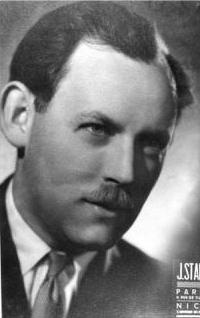
Hillel Kook aka “Peter Bergson”
by Isabel Kershner
When 20 people gathered for a modest ceremony in the tranquil cemetery of this kibbutz in central Israel last month, the intimacy and quiet dignity of the event belied the tumultuous historical forces coursing beneath it.
The occasion was the reinterring of the remains of Samuel Merlin, a founder of a small but brazen band of militant Zionists and Holocaust rescue activists who shook America and challenged the Jewish establishment in the 1940s, but who until recently have been largely excluded from official Holocaust history.
The activists, known as the Bergson group, have been credited by modern historians with playing a pivotal role in rescuing hundreds of thousands of European Jews.
But the group was rejected by the Jewish establishment it challenged, both in the United States and in Israel, where its militant tactics and right-wing Zionism clashed with the mainstream. Mere mention of the group stirs up old passions and painful questions about what America did or did not do to save European Jewry, and the extent to which schisms within Jewish ranks hampered more effective action.
More recently, prominent historians have begun to recognize the group’s achievements. On July 17, Yad Vashem, the official Holocaust remembrance authority in Jerusalem, which had ignored the Bergson group in its exhibits, held a symposium on it for the first time.
For those attending the reburial of Mr. Merlin a few days earlier, including some widows and children of the group’s members, the event was a symbolic start of a process of reconciliation.
[……]
The Bergson group formed in 1940 when about 10 young Jews from Palestine and Europe came to the United States to open a fund-raising and propaganda operation for the Irgun, the right-wing Zionist militia. The group was organized by Hillel Kook, a charismatic Irgun leader who adopted the pseudonym Peter H. Bergson. Mr. Merlin was his right-hand man.
The group began by raising money for illegal Jewish immigration to what was then the British Mandate of Palestine and promoting the idea of an army composed of stateless and Palestinian Jews. But the mission abruptly changed in November 1942 after reports of the Nazi annihilation of two million European Jews emerged. Like earlier reports of the mass killing of Jews, the news barely made the inside pages of major American newspapers like The New York Times and The Washington Post.
The Bergsonites were appalled by what they saw as the indifference of the Roosevelt administration and the passivity of the Jewish establishment, which staunchly supported the administration and largely accepted its argument that the primary American military objective was to win the war, not to save European Jews. The group embarked on a provocative campaign to publicize the genocide and to lobby Congress to support the rescue of Jews, roaming the hallways of Capitol Hill and knocking on doors, displaying a degree of chutzpah that made the traditional, pro-Roosevelt Jewish establishment uncomfortable.
The group took out a series of fiery, full-page advertisements in The New York Times and other major dailies highlighting the mass murder, soliciting donations at the bottom of each one to pay for the next. With help from celebrity supporters like the director and writer Ben Hecht, the impresario Billy Rose and the composer Kurt Weill, they staged a flamboyant pageant called “We Will Never Die,” filling Madison Square Garden twice before sending the show on the road.
In October 1943, the Bergson group organized a march of 400 Orthodox rabbis on the White House, most of them in traditional black garb, a spectacle the likes of which had never been seen in Washington.
Finally, in January 1944, under heavy pressure from the Treasury secretary, Henry Morgenthau Jr., President Franklin D. Roosevelt set up the War Refugee Board by executive order, leading to the rescue of 200,000 Jews.
“Without Hillel Kook and the Bergson group,” said David S. Wyman, author of the book “The Abandonment of the Jews: America and the Holocaust 1941-1945,” which first re-evaluated the role of Bergsonites, “there would have been no War Refugee Board.”
Yet the American Jewish leadership at the time fought the newcomers, saying their tactics would lead only to increased anti-Semitism. Rabbi Stephen Wise, the Jewish community’s chief representative, wrote to a colleague in 1944 that the Bergsonites “are a disaster to the Zionist cause and the Jewish people.”
Jewish American leaders were apparently afraid of making waves, and of losing their own prominence.
“This was an era in which militant civil action was just not done, certainly not by Jews,” said Charley Levine, an Israeli-based international communications and public relations expert who has studied the Bergson group. “This was before Vietnam.”
[……]
The dissension led to the Bergson group’s being blanked out of the early histories of the Holocaust. “My father and his group went against the grain of those writing the narrative of the war,” said Mr. Kook’s daughter, Rebecca Kook, now a political scientist at Ben Gurion University of the Negev in Israel.
But with the perspective of time and the opening of additional Holocaust era archives, including Mr. Merlin’s, the Bergson group has begun to be reworked into Jewish history. After years of campaigning by Mr. Medoff and others, the United States Holocaust Memorial Museum in Washington included a small exhibit on the group in 2008.
[……]
In a foreword to the book, Seymour D. Reich, a veteran leader of major Jewish organizations, wrote, “The time has come to acknowledge, unequivocally, that Rabbi Wise and his colleagues were wrong.”
Instead of attacking Mr. Bergson, they should have focused on the rescue mission, he wrote, adding, “That was their obligation, and they failed.”
Read the rest – Belatedly Recognizing Heroes of the Holocaust
For further information on the two fights of the Bergson Group (one against the Holocaust and the other against the American Jewish Establishment), this excellent article from 2007 should be read.
The Bergson Group vs. the Holocaust – and Jewish Leaders vs. Bergson by Rafael Medoff
Tags: Isabel Kershner, Rafael Medoff