
Christmas is clumping, the geezer’s getting fat
It’s an open…the Holidays are soon upon us.



Christmas is clumping, the geezer’s getting fat
It’s an open…the Holidays are soon upon us.
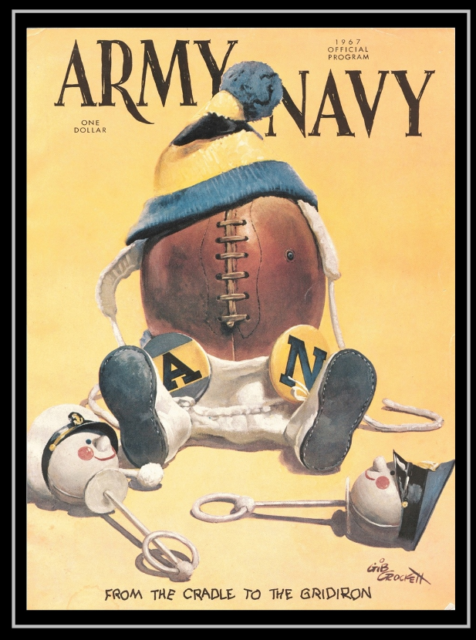
Ah, yes! the 2021 Army Navy football game is upon us!
 |
3:00 PM | CBS |
The line is 6.5 with Army as the favorite. Each team is under 100yds of passing per game. This is a run oriented game from the wing formation. I’m not betting on this because this game gets way too unpredictable. the cadets/midshipmen with the most will and heart win.
Me and the girls are up at G’ma and Papap Coldwarrior’s palatial estate up north (Mrs Coldwarrior is on night shift at home this weekend). Papap Coldwarrior is thinning out the contents of the Legendary Garagemahal. Tools and devices from almost 40 years of high level (nuclear) machinist work have been given away to the local trade school. For the life of me, I couldn’t figure out what most of that stuff was, it looked pretty damned technical tho. I got three things. His original tool box from when he apprenticed at Penn Machine under his father in law, Great Grandfather Pappap Coldwarrior. And I got Great Grandfather Pappap’s master-machinist tool box and micrometer!
Interestingly, Dad (Pappap Coldwarrior) was offered to go to Australia twice. First with Penn Machine in the late 60’s, then again for LWBR set up in the late 70’s early 80’s by the Aussie govt who were not ever trying to make their own nukes, ever. No, really, ever. For realz! We came within a few weeks of moving down-under, it was a great offer and was almost accepted.
I had no idea how talented Pappap Coldwarrior was until his retirement party. Machinists from other stations and even other systems (from over 1000 mile away) came to it and talked about him…’innovative…extremely talented…genius’…the CEO of the company even made a speech. And here I thought he was just a grumpy, hyper-exacting, moody, metal turner!
He isn’t getting around too well right now, industrial disease. He’s has a new R shoulder, new R hip, new L knee, one more joint to go, the R knee this January. (The steroid shots quit working). His goal, walk 9 holes of golf by May, 18 by August.
Bionic and Ironic…’The Machinist’ saved by machined joints.
ITS AN OPEN AS WELL
The Ashes series starts Tuesday (1900EST US) in Brisbane, Australia. Since the 1880’s, England has been playing Australia every two years in one of the most heated rivalry in Test Cricket. They play for a lovely Waterford Crystal Urn that is a replica of the urn that, according to legend, contains the burned Cricket bails that represent ‘The Death of English Cricket” after their loss to Australia in 1882-3.
This isn’t simply a test match.
Test cricket is the form of the sport of cricket with the longest match duration and is considered the game’s highest standard.[1][2] Rotary Test matches are played between national representative teams that have been granted Test status, as determined and conferred by the International Cricket Council (ICC). It is called Test because the long, gruelling matches are mentally and physically testing.[3] Two teams of 11 players each play a four-innings match, which may last up to five days (or more in the past). It is generally considered the most complete examination of a team’s endurance and ability.[4][5][6]
This is rivalry at it’s highest that transcends sport. This is Mother Country versus one of ‘the Colonies’ with two years of bragging rites and pride on the line. Australia have won 33, England 32, there have been 6 draws. Yes, there can be a draw after 5 days of cricket and even after a whole series. the rules for a draw in test cricket are well beyond the scope of this post, however. And yes, there is a very small chance for a tie.
They will play Test Cricket in several venues around Australia and culminate in Perth in Mid January. .
A standard day of Test cricket consists of three sessions of two hours each, the break between sessions being 40 minutes for lunch and 20 minutes for tea. However, the times of sessions and intervals may be altered in certain circumstances: if bad weather or a change of innings occurs close to a scheduled break, the break may be taken immediately; if there has been a loss of playing time, for example because of bad weather, the session times may be adjusted to make up the lost time; if the batting side is nine wickets down at the scheduled tea break, then the interval may be delayed until either 30 minutes has elapsed or the team is all out;[21] the final session may be extended by up to 30 minutes if 90 or more overs have not been bowled in that day’s play (subject to any reduction for adverse weather);[22] the final session may be extended by 30 minutes (except on the 5th day) if the umpires believe the result can be decided within that time.[23]
More info and some fine articles can be found here.

It’s Championship Weekend. Last Week it was a wash, 3/6, total:33/49 : $1400/$1000.after this the top 4 teams go to a playoff to decide who is the big kahuna. I gotta redeem myself!
FRIDAY:
 #10 Oregon |
 #17 Utah |
8:00 PM |  |
Oregon often reminds me of Ohio State, always over-rated and chokes in the big game. To wit, Utah is lower ranked but favored by 2.5 points. So they are the favorite yet lower ranked. They cover the spread. The PAC-10 stinks.
SATURDAY:
 #9 Baylor |
12:00 PM | |
OSU survived BEDLAM last week and are now 5.5 point favorites to beat the Baylor Bears. If OSU covers, they should make the playoffs. They cover.
 |
12:00 PM |  |
That’s right! Kent State Golden Flashes are in the MAC FINAL! Bunk will be up extra early to cheer on his Alma Mater.
 #1 Georgia |
 #3 Alabama |
4:00 PM | CBS |
This is the Big One, The SEC Championship. This opened a couple days ago with the Georgia Bulldogs only a 4 point favorite (the line has moved to 7). Saban very rarely loses two in a row, however, I think the Bulldogs can cover 4 points.
 #21 Houston |
 #4 Cincinnati |
4:00 PM | |
I’m sorry, Cincinati does not deserve to be mentioned in the playoff picture, they are a mid-major at best and will be crushed by the other teams in the playoffs.
 #2 Michigan |
 #13 Iowa |
8:00 PM | FOX |
M beat the over-rated, and their much hated rival, Ohio State last weekend. This weekend the line for the Big 10 championship has M as an 11 point favorite. I can see M not covering.
 #15 Pittsburgh |
 #16 Wake Forest |
8:00 PM | |
It’s my beloved Panthers in the ACC championship versus the Demon Deacons. (If Miami were in PITT’s shoes, the Hurricanes would be ranked in the top 8. Always grossly over-rated). PITT is a 3 point favorite and covers. PITT QB, Pickett, will be drafted in the first round, and playing on Sunday. He should have a big game.


 The Diary of Daedalus
website design was Built By All of Us


