As always, the most current Space Weather can be found here. Today’s Saturday Lecture Series is a primmer on Solar Cycles and the interaction of the Earth’s magnetic field to the charges particles that are emitted from the Sun. So sit back, have a read and watch some videos and get ready for Solar Maximum!
April 1, 2009: The sunspot cycle is behaving a little like the stock market. Just when you think it has hit bottom, it goes even lower.
2008 was a bear. There were no sunspots observed on 266 of the year’s 366 days (73%). To find a year with more blank suns, you have to go all the way back to 1913, which had 311 spotless days: plot. Prompted by these numbers, some observers suggested that the solar cycle had hit bottom in 2008.
Maybe not. Sunspot counts for 2009 have dropped even lower. As of March 31st, there were no sunspots on 78 of the year’s 90 days (87%).
It adds up to one inescapable conclusion: “We’re experiencing a very deep solar minimum,” says solar physicist Dean Pesnell of the Goddard Space Flight Center.
“This is the quietest sun we’ve seen in almost a century,” agrees sunspot expert David Hathaway of the Marshall Space Flight Center…Deep calm was fairly common a hundred years ago. The solar minima of 1901 and 1913, for instance, were even longer than the one we’re experiencing now. To match those minima in terms of depth and longevity, the current minimum will have to last at least another year.

Oddly enough, global temperatures coincide with the below graphed averaged sunspot numbers…Maunder Minimum sure does line up just perfectly with the Little Ice age…but that’s a topic for later. Today we need to hear about the Sun and some Solar Physics before we get into that.

So, in the next year we will be entering the 6 year period of Solar Maximum, the period where the Sun has much more spots and throws off more flares into Solar System…Sunspots and their associated magnetic fields follow an 11-year activity cycle. This composite image shows ten magnetic maps of the Sun observed approximately one year apart, from one maximum of activity almost to the next. As activity fades, the large regions disappear and only small ones generated near the surface continue to emerge, creating a salt-and-pepper pattern of ephemeral magnetic regions that persists through time. As the next cycle of activity picks up, the magnetic polarities of the active regions that emerge from deep inside the Sun are reversed. This means that although the sunspot number and the coronal activity have an eleven-year cycle, the full magnetic cycle is actually twenty-two years. Images: Kitt Peak telescope of the National Solar Observatory.

Exploring Space Lectures 2008: The Day the Earth Caught Fire, From the Smithsonian:
NASA | Sentinels of the Heliosphere:
Solar Particles and Earth’s Magnetic Field:
As an aside for high latitude Northern Hemisphere observers, when at solar minimum (and at a period of no sunspots and low activity), Noctilucent Clouds are more likely to be seen.
ELECTRIC BLUE CLOUDS: Observers in Europe are reporting brightening displays of noctilucent clouds (NLCs). “On June 16th, a stunning display appeared in the skies over Northern Ireland,” reports Martin McKenna. “Here they are glowing over the famous ‘Toome Bridge’ in County Antrim.”
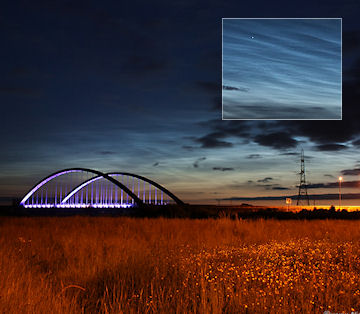
“The clouds stretched more than 160 degrees across the sky with wonderful electric blue colours,” he adds. “Well-formed bands and whirls could be seen moving in real time.”
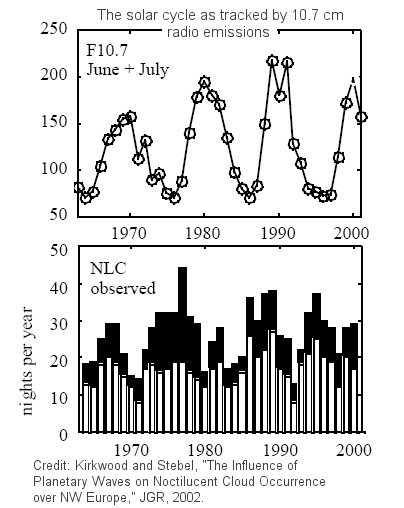
Summer is the season for NLCs, and sightings should increase in frequency as the season unfolds in the weeks ahead. The solar cycle also favors a good show: There is a well-known correlation between noctilucent clouds and sunspots. NLC activity tends to peak during years of solar minimum, possibly because low solar activity allows the upper atmosphere to cool, promoting the growth of ice crystals that make up the clouds. With the sun slowly emerging from a century-class minimum, the stage is set for a good season of NLC watching.
more images: from John C McConnell of Maghaberry, Northern Ireland; from Michael Alexander of Galloway Astronomy Centre, Glasserton, Dumfries & Galloway, Scotland; from Peter McCabe of Dundalk, Co.Louth, Ireland; from Conor McDonald of Maghera, Ireland; from Pete Glastonbury of Avebury, Wiltshire, UK; from Stuart Atkinson of Kendal, Cumbria, UK; from George of Moscow, Russia;
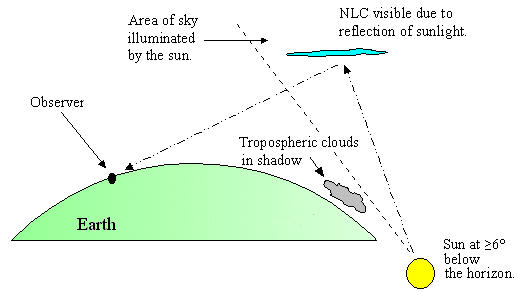
Observing tips: Look west 30 to 60 minutes after sunset when the Sun has dipped 6o to 16o below the horizon. If you see luminous blue-white tendrils spreading across the sky, you may have spotted a noctilucent cloud. High-northern latitudes are favored.