► Show Top 10 Hot Links

Posts Tagged ‘History’

Saturday Lecture Series: The Dark Ages

by coldwarrior ( 39 Comments › )
Filed under Academia, History, Open thread, saturday lecture series at December 11th, 2010 - 8:30 am

Today we return to Prof Eugen Weber’s course, ‘The Western Tradition’.  Today he discusses: The Dark Ages .

.

Please follow this link out to 17 The Dark Ages

.

The Barbarian kingdoms took possession of the fragments of the Roman Empire. As the Barbarians became Christianized, the Christian Church is influenced by them, the legends of ‘supernatural power’ of the saints is on the rise as patron while the leaders of the church become violent and unjust at times, and conversion is done by a new power that impressed and subdued the barbarians.

The ruling classes are gradually changed and succession to power is stabilized by the church’s decrees. The church offers an escape from the ‘doomed world’ to those that are baptized and follow.  Monasteries and Convents start as a refuge, and mature during this period.  They then spread the word, educate, convert, and transcribe, and write. The Monasteries are an interesting counterpoint to society in general.

A glimpse of our pre-industrial past

by 1389AD ( 151 Comments › )
Filed under Art, Economy, History, Leftist-Islamic Alliance, Music, Open thread, Russia, Transportation at December 8th, 2010 - 4:30 pm

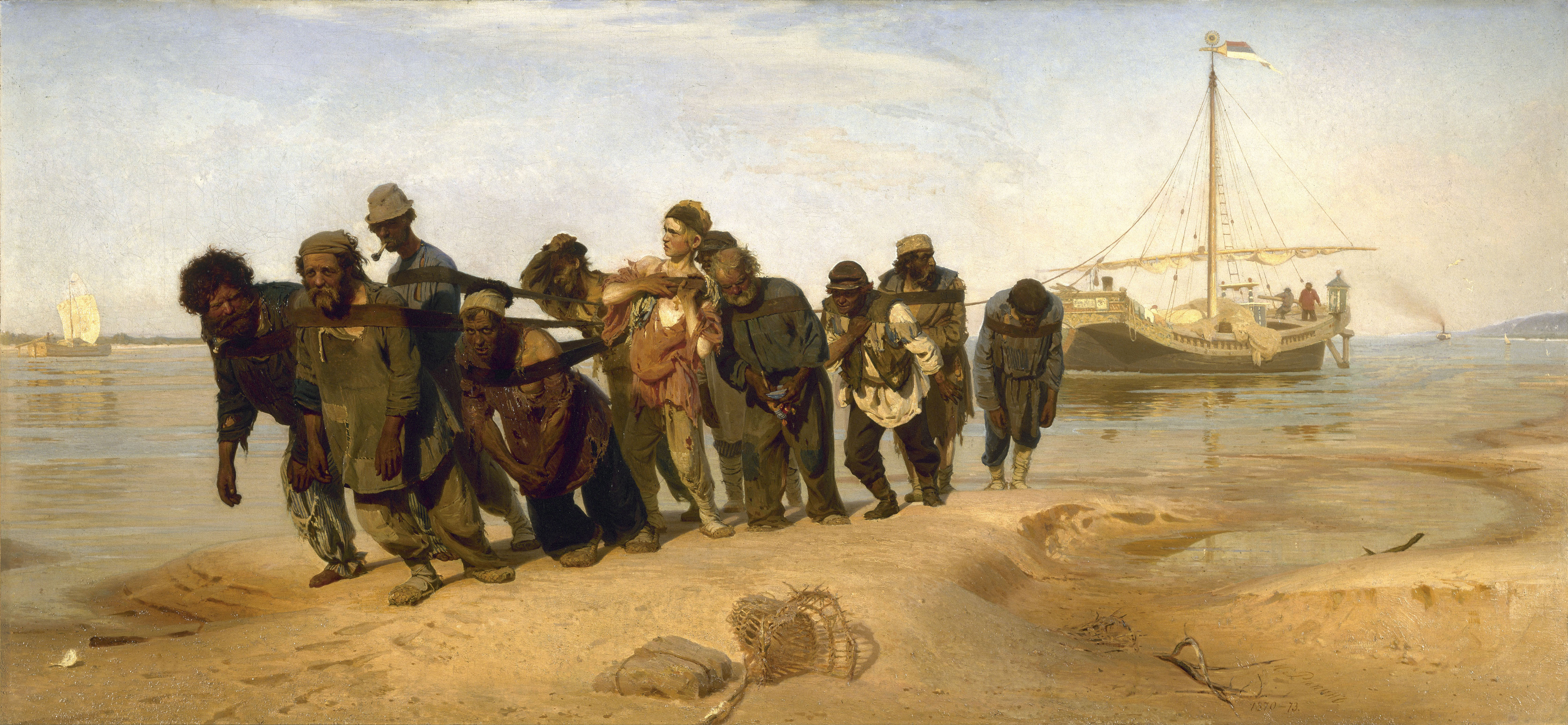
Look closely at this masterpiece by the Ukrainian artist Ilya Repin.

It is worth clicking the image to see a larger view.

Barge Haulers on the Volga by Ilya Repin

Barge Haulers on the Volga

This is what life was like for too many people in a pre-industrial society.

Read the Wikipedia article. Some of the people pulling the barge had once been part of what passed for the middle class in that place and time. Once they lost their footing in the middle class, this was their fate. As far as I know, none were convicts – they were just people down on their luck and desperate to make some sort of a living. Their only option was to hire themselves out for toil too arduous even for a beast of burden.

Barge Haulers is inspired by scenes witnessed by the artist while holidaying on the Volga in 1870. He made a number of preparatory studies, mostly in oil, while staying in Shiriaev Buerak, near Stavropol. The sketches include landscapes, and views of the Volga and barge haulers.

The characters depicted are based on actual people whom the artist came to know while preparing the work. He had had difficulty finding subjects to pose for him, even for a fee, because of a folklorish belief that a subject’s soul would leave his possession once his image was put down on paper. The subjects include a former soldier, a former priest, and a painter. Although Repin depicted eleven men, women also performed the work and there were normally many more people in a barge-hauling gang; Repin selected these figures as representative of a broad swathe of the working classes of Russian society. That some had once held relatively high social positions dismayed the young artist, who had initially planned to produce a far more superficial work contrasting exuberant day-trippers (which he himself had been) with the careworn burlaks. Repin found a particular empathy with Kanin, the defrocked priest, who is portrayed as the lead hauler and looks outwards towards the viewer.
[…]
Barge Haulers on the Volga shows a row of eleven male burlaks dragging a barge on the Volga River that must be pulled upstream against the current. The men are dressed in rags and bound with leather harnesses. They are rendered as mostly stoical, although in obvious physical discomfort, with their bodies bowed in toil. The scene is rendered in a white, silvery light which has been described as “almost Venetian”. In earlier studies, it was dominated by blue tones.

The men appear to be unsupervised and form the focus of the picture, with the barge relegated to a minor role at the rear of the frame. Further in the distance is a tiny steam-powered boat, perhaps a suggestion that the back-breaking labour of the barge haulers is no longer necessary in the industrial age. Also worthy of note is the inverted Russian flag flying from the main mast of the barge suggesting adding to the sense that something is not quite right. Repin echoes the stop-go rhythm of the labour in the undulating line of the workers’ heads. In the preparatory studies, many of the figures were positioned differently; for example the second man was shown wearing a cap with his head bowed into his chest.

There is a general sense of mounting exhaustion and despair moving from left to right amongst the group; the last hauler seems oblivious to his surroundings and drifts from the line out towards the viewer. The exception is a fair-haired boy in the centre of the group. Set brightly against the uniform muted tones of his companions, his head is raised looking into the distance, while he pulls against his straps as if determined to free himself from his task…

Russian and Ukrainian society at that time had too little infrastructure to support much of a middle class. It was not simply a matter of income inequality…there was too little wealth to go around, because too little wealth was being produced. Industrialization was still in its infancy. Fossil fuels were in very limited use.

Sound familiar?

This is what the leftist/green/pro-jihadi convergence wants – not for themselves, of course – but for us.

Be thankful that it is not OUR faces staring out of that bleak canvas.

Not yet, anyway.


Leonid Kharitonov & Red Army Choir – Song of the Volga Boatmen (Live)
(h/t: The Osprey)


Feodor Chaliapin – Song of Volga Boatmen (1936)


Edmund Fitzgerald, 35 Years ago tonight.

by coldwarrior ( 143 Comments › )
Filed under History, Open thread at November 10th, 2010 - 6:30 pm

.

Since 1814, The Great Lakes have taken 240 ships, over 6000 souls. The most famous wreck occurred 35 years ago tonight. The SS Edmund Fitzgerald went down in a very bad November storm, the Great Lakes claimed the Fitz’s 29 Crewmen. These Lake Freighters are oil fired and around 730 feet long and can carry about 26, 000 short tons of ore, they are not delicate ships. They are made for rough weather on the Lakes and hauling heavy loads. The Fitz was on one of the last runs of the year as the weather can get very bad on the Lakes in November. The weather forecast was for a normal November storm and called for a small craft warnings as the storm was predicted to move over eastern Lake Superior. The Fitz was on Lake Superior, followed by another Lake Freighter, the Arthur Anderson. The pair were traveling South to Detroit in what became a gale-force storm. The Fitz sank 17 miles short of their emergency destination, the relative safety of Whitefish Bay.

The storm that she sailed into was measured at 28.90″ Hg and dropping,  60-70mph steady winds/100mph gusts,  and 30 foot waves. The wind produces rogue waves that can hit 50 feet or more. Capt McSorley stated that this was the worst storm he had ever seen, he had 44 years on the Lakes.  The storm’s barometric pressure is one of the lowest non-hurricane readings ever recoded on the North American continent. This was an inland Cat 1 Hurricane. I have been in two of these “Witches of November”, thankfully on dry land. These types of storms rage across the Great Lakes in the late fall and early winter and have taken 5 ships and hundreds of lives since 1913. Please see this excellent meteorological description of events that uses Gordon Lightfoot’s lyrics from the song “The Wreck of the Edmond Fitzgerald” as the narrative.

The theory of why the Fitz sank is that she was hit by what is referred to as the Three Sisters, groups of 3 massive rouge waves that broadsided the Fitz, and damaged some of the two-ton hatch covers allowing massive amounts of water to pour into the cargo hold as more and more waves smashed into her. The Fitz’s bilge pumps could not keep up and the added weight ether caused a structural failure, or she just ceased to be buoyant and went in nose first. Either way, she sank very rapidly because the life boats were not readied and no S.O.S was given by the Captain.

Here is a write-up from wiki taken from the NTSB reports:

Late in the afternoon of Monday, November 10, sustained winds of 50 knots were observed across eastern Lake Superior. Anderson was struck by a 75-knot (139 km/h; 86 mph) hurricane-force gust. At 3:30 pm, Captain McSorley radioed the Anderson to report that she was taking on water and had top-side damage including that the Fitzgerald was suffering a list, and had lost two vent covers and some railings.[9][13] Two of the Fitzgerald‘s six bilge pumps were running continuously to discharge shipped water.[5]

At about 3:50 pm, McSorley called the Anderson to report that his radar was not working and he asked the Anderson to keep them in sight while he checked his ship down so that the Anderson could close the gap between them. Fitzgerald was ahead of Anderson at the time, effectively blind; therefore, she slowed to come within 10 miles (16 km) range so she could receive radar guidance from the other ship.[13] For a time the Anderson directed the Fitzgerald toward the relative safety of Whitefish Bay. McSorley contacted the U.S. Coast Guard station in Grand Marais, Michigan after 4:00 pm and then hailed any ships in the Whitefish Point area to inquire if the Whitefish Point light and navigational radio beacon were operational. Captain Cedric Woodard of the Avafors answered that both the light and radio direction beacon were out at that moment. Around 5:30 pm, Woodward called the Fitzgerald again to report that the Whitefish point light was back on but not the radio beacon. When McSorley replied to the Avafors, he commented, “We’re in a big sea. I’ve never seen anything like it in my life.”[9][13]

The last communication from the doomed ship came at approximately 7:10 pm, when Anderson notified Fitzgerald of an upbound ship and asked how it was doing. McSorley reported, “We are holding our own.” A few minutes later, it apparently sank; no distress signal was received. Ten minutes later Anderson could neither raise Fitzgerald by radio, nor detect it on radar. At 8:32 pm, Anderson was finally able to convince the U. S. Coast Guard that the Fitzgerald had gone missing.[11] Up until that time, the Coast Guard was looking for a 16 foot outboard lost in the area. The United States Coast Guard finally took Captain Cooper of the Anderson seriously shortly after 8:30 pm. The Coast Guard then asked the Anderson to turn around and look for survivors.

35 Years ago tonight the Edmund Fitzgerald went under in a horrible storm, 29 men died, 29 families lost someone very special to them.The Fitz is in 530 feet of water, broken in two with the midship in several pieces, the discolored iron ore pellets from her hold are strewn about the lake bed.

So, here is a toast to the Crew and to the other 6000 that have died sailing the Great Lakes. Rest in Peace.

A montage of clips and actual radio transmissions with Gordon Lightfoot singing The Wreck of the Edmund Fitzgerald:

.

BLOGMOCRACY UPDATE:

HAPPY BIRTHDAY, USMC!