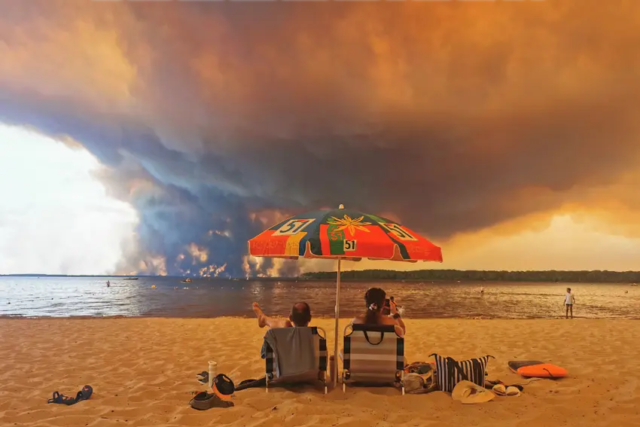
Beach goers at Moutchic on the shore of Lake Lacanau (Etang de Lacanau) in Lacanau , southwestern France on July 24, 2026, as clouds of smoke rise into the sky from the Gironde wildfire. Photo by Maximilien LAMY / AFP
Story here.


Beach goers at Moutchic on the shore of Lake Lacanau (Etang de Lacanau) in Lacanau , southwestern France on July 24, 2026, as clouds of smoke rise into the sky from the Gironde wildfire. Photo by Maximilien LAMY / AFP
Story here.

Although it’s been in my blog roll for years, it’s been a while since I ventured over to No Puedo Creer. “I Can’t Believe It” is a great website from Spain, and I’d use it to practice hobbling the spaniel with some of the commenters.
Without cheating, guess what those things are. You’re going to be amazed and disgusted at the same time, I guarantee it. I’ll update the thread with a link in an hour or so, so we can all be amazed and disgusted together on
The Overnight Open Thread.
_____________________________________
[Update: Do not click on this link if you haven’t read the thread or guessed as it’ll spoil the fun.]
(h/t: yenta-fada)

Business Dictionary offers a long-winded, technical definition of sovereign debt. In a nutshell, sovereign debt is debt that a government owes. If a debtor government cannot repay its debt, its creditors (bondholders) do not have the power to force it into bankruptcy and divide up its remaining assets. So if the debt goes bad, both the debtor government and its creditors are in a predicament.
Government debt. Under the doctrine of sovereign immunity, the repayment of sovereign debt cannot be forced by the creditors and it is thus subject to compulsory rescheduling, interest rate reduction, or even repudiation. The only protection available to the creditors is threat of the loss of credibility and lowering of the international standing (the sovereign debt rating) of the country which may make it much more difficult to borrow in the future.

Note: The above video makes some valid points about the financial house of cards that various governments are busily trying to prop up. That said, I place no faith in the ability of the IMF or any other international financial organization to do anything other than worsen the crash by attempting to delay the inevitable.
I also must point out that there is a tremendous difference between a private enterprise with a good credit rating borrowing at a low interest rate to invest in future productivity, and a government borrowing money for supposedly the same reason. Experience has proven governments to be incapable of investing borrowed money in anything that will result in economic expansion.
The real outcome of such wasteful spending will be more like this chilling ad by Citizens Against Government Waste (CAGW):

Originally published on 1389 Blog.

Noche de Rabanos (Night of the Radishes) takes place every year, on the 23rd of December, in Oaxaca, Spain and is one of the most impressive vegetable festivals around the world.
The radish was brought to the Americas in the 16th century, and back then the vendors used to carve them and use them on their market stalls to attract customers. Although the origins of the festival cannot be traced to an exact period, it is considered that it all began in the year 1897, when the mayor of Oaxaca organized the first radish-art exposition. Everever since that first celebration, every year, this humble vegetable is meticulously carved into animals, warriors, kings, dancers and pretty much any shape you can imagine. The artists sometimes make use of other vegetables, like onion or lettuce to complete their work. There’s also a prize for the most beautiful piece displayed.
The carver’s work begins about three days in advance and on the 23rd of December, the day of the festival, the results of all their hard work is presented to the public. On that same day, especially in the morning, children have the chance to learn this incredible art of radish-carving, or at least some of its secrets.
The celebrations don’t end that day. They continue on Christmas Eve and Christmas Day with other joyful “fiestas”, parades of floats, fireworks music and dancing.
Original story with more images from here. En honor a este día glorioso, obtener su rábanos, tallar ellos y enviar fotos para El Hilo Abierto de la Noche a la Mañana.


 The Diary of Daedalus
website design was Built By All of Us
